Loading form...

Kiến thức bất động sản Mua - Bán

Posts in this category

Apr 14, 2026

Step-by-Step Guide to Buying a House in Japan for Foreign Residents

Are you living and working in Japan, dreaming of owning your own home? The process of buying property in an unfamiliar country, with language barriers and a different legal system, can leave many Vietnamese feeling confused about where to start. This article will walk you through the complete steps to buying a house in Japan from A to Z, from loan pre-screening to receiving the keys, so you can move forward confidently on your journey to settling down in this country.Why Is It Important to Understand the Home-Buying Process in Japan?For foreigners — especially Vietnamese residing in Japan on work visas, engineer visas, or as international students — buying a house isn't as simple as purchasing an ordinary product. It involves banks, legal contracts, and a range of documents that need to be carefully prepared.Understanding the process will help you:Proactively prepare the necessary documents and save timeCorrectly understand your rights and obligations when signing the contractAvoid unnecessary financial risksBelow are the 6 basic steps in the home-buying process in Japan that you need to know.Step 1: Jizenshinsa (事前審査) – Pre-Screening AssessmentThis is the first and most important step in buying a house in Japan, as it helps determine your borrowing capacity before you start house hunting.The Real Estate Agent Discusses Your NeedsThe supporting real estate agency will speak with you directly to understand:Your desired living areaType of property (new house, used house, apartment, or whole house)Your expected budgetCollecting Documents for Bank AssessmentOnce your needs are understood, the agency will guide you in gathering the necessary documents to submit to the bank. The bank will use these documents to:Determine the maximum loan amount you may be approved forProvide an estimated interest rateThe result of this pre-screening assessment serves as the basis for determining your realistic budget when searching for a home.Step 2: Finding and Deciding on a HouseOnce you know your financial capacity, you can move on to the next important step: house hunting.Searching for a Home That Matches Your PreferencesBased on the criteria discussed in Step 1 (area, property type, budget), the agency will introduce properties that best match your needs.Viewing the Property in PersonYou should visit the property in person to evaluate:The actual condition of the houseThe surrounding environment, transportation, and amenitiesDirection, natural light, and noise levelsDeciding on Your Preferred PropertyAfter careful consideration, you finalize your choice and move on to the contract-signing stage.Step 3: Signing the Sales Contract (売買契約)This step carries significant legal weight, so it's essential to fully understand every clause before signing.Drafting and Explaining the ContractThe real estate agency and the seller will jointly draft the sales contractThe contract's contents will be explained in detail to the buyerThe buyer must thoroughly understand every term before proceeding to signAffixing the Contract Stamp and Paying the DepositOnce you agree to the contract terms, the following steps take place:Affixing the revenue stamp (印紙) as required by lawPaying a deposit, typically around 10% of the property's valueThe deposit amount is often negotiable, with a common amount being around 1 million yen (100 man yen).Step 4: Honshinsa (本審査) – Final Loan AssessmentAfter signing the contract, the bank will require you to submit all necessary documents for the final loan assessment.Unlike Jizenshinsa (which is only a preliminary reference assessment), Honshinsa is the final assessment stage that determines whether the bank will officially approve your loan.Step 5: Final Property Inspection Before HandoverThis step typically applies to new properties (which were already inspected during the initial viewing stage).Before the official handover, three parties will jointly conduct a final inspection of the property:The buyerThe sellerThe intermediary real estate agencyThe purpose of this step is to ensure the property matches exactly what was agreed upon in the contract, with no damage or discrepancies before finalizing the transaction.Step 6: Final Settlement and HandoverThis is the final step, marking the completion of the entire home-buying process in Japan.The tasks involved in this step include:The bank transfers the loan amount to the buyerThe buyer pays related fees (brokerage fees, notarization fees, registration tax, etc.)Receiving the house keys, officially becoming the property ownerAfter this step, your home-buying process in Japan is complete.SummaryThe home-buying process in Japan consists of 6 main steps: Pre-screening assessment (Jizenshinsa) → Finding and deciding on a house → Signing the sales contract → Final loan assessment (Honshinsa) → Final inspection before handover → Settlement and key handover.Understanding each step will help Vietnamese people in Japan — whether working visa holders or long-term foreign residents — be more proactive in preparing documents and finances, and make sound decisions when buying a home.If you're looking to buy a house in Japan and need support, please contact a trusted real estate agency for advice tailored to your specific situation.

Apr 14, 2026

"Buying a House in Japan: What Other Costs Should You Prepare Besides the Property Price?"

ESTATE PLUSBuying a House in Japan: Beyond the Property Price, You Need to Prepare an Additional 6-10% in Upfront CostsWhen deciding to buy a house in Japan, most people focus on the most important questions: How much does the house cost? How much can I borrow from the bank? How much will I pay each month? These are the most critical numbers, but they're not the whole financial picture.In reality, when buying a house in Japan, on top of the purchase price, buyers typically need to prepare an additional 6~10% of the property value for upfront costs - including contract stamp tax, ownership registration fees, fire/earthquake insurance, the first year's fixed asset tax, bank fees, and brokerage fees. For a house priced at 30 million yen, this can amount to 1.8~3 million yen.These are costs with clear regulations and calculation formulas, so they can be fully planned for in advance once you understand each item. In this article, the ESTATE PLUS consulting team will help you break down every cost involved in buying a house in Japan that foreigners need to prepare for - from the purchase procedures to the annual taxes due after owning the property - so you can plan your finances proactively and accurately.1. Overview: What Do the Upfront Costs of Buying a House in Japan Include?When it comes to buying a house in Japan, most buyers - especially first-time foreign buyers - typically only think of two major items: the down payment and the monthly bank installment. However, the real estate purchase process in Japan involves many mandatory legal, administrative, and financial procedures, each of which incurs its own cost.Altogether, these costs typically fall within the range of 6~10% of the property value. These are regulatory costs that will appear in almost every real estate transaction in Japan, and can be fully anticipated in advance once you understand each item.This difference sometimes surprises Vietnamese buyers, because in Vietnam, the additional fees involved in buying a house are often not as clearly itemized and disclosed as they are in Japan. Knowing the list and calculation method for each cost in advance will help you:•        Prepare the exact amount of money you need to have on hand (not just the down payment)•        Avoid running short on funds right before signing the contract•        Be able to compare and negotiate to optimize certain fees (such as brokerage fees and bank fees)In the next section, we'll go through each specific cost in detail.2. Detailed Breakdown of Costs Payable When Buying a HouseThis is the group of costs you need to prepare during the contract-signing stage and the ownership transfer procedures. It includes the following 6 main items:2.1. Contract Stamp Tax (印紙税 - Inshizei)This is a mandatory tax stamp affixed to the property sale contract, serving to confirm the legal validity of the document.The stamp tax rate varies depending on the contract value, typically ranging from 10,000 yen ~ 60,000 yen. The higher the contract value, the higher the applicable stamp tax.2.2. Ownership & Mortgage Registration Fee (登記費用 - Touki Hiyou)When buying a house, you need to register ownership of the property (and register the mortgage, if you're taking out a bank loan) with the registration authority. This procedure cannot be done yourself - it requires going through a Judicial Scrivener (司法書士 - Shihou Shoshi).A small but important note: many Vietnamese buyers often refer to a 司法書士 as a “lawyer,” but this is actually a distinct profession in Japan, specializing in legal registration procedures related to land and property - not a litigation lawyer (弁護士). This registration fee includes both the government statutory fee and the fee paid to the judicial scrivener.2.3. Fire and Earthquake Insurance (火災保険・地震保険)This insurance is essentially mandatory, especially when taking out a bank loan to buy a house (banks usually require fire insurance as a condition for disbursing the loan).This insurance is typically purchased in packages with different term options:•        1-year package: lower premium but must be renewed annually•        3-year package: balances cost and convenience•        10-year package: higher initial total cost but more economical in the long run, with no need to worry about frequent renewals2.4. First-Year Fixed Asset Tax (固定資産税 - prorated portion based on handover date)This is the item most likely to cause confusion, so let's analyze the calculation principle carefully:In Japan, fixed asset tax (固定資産税) is calculated annually, but when a transaction takes place partway through the year, that year's tax is prorated based on the actual number of days of ownership between the previous owner and the new owner.•        The previous owner is responsible for the portion of tax up to the day before the handover date.•        Starting from the exact handover date, the property officially belongs to you, so you'll need to pay the portion of tax corresponding to the remaining days from the handover date through December 31 of that year.Illustrative example:If you receive handover of the house on September 1, you'll need to pay the fixed asset tax for the period from September 1 to December 31 (122 days), while the previous owner bears the portion from January 1 to August 31.2.5. Bank Fee for Home Loans (銀行の手数料)When you take out a bank loan to buy a house, the bank will charge a loan processing fee. The common calculation formula is:Bank fee = 2.2% × Loan amountPractical example:If you borrow 30 million yen (30,000,000 yen) to buy a house, the bank fee is calculated as follows:30,000,000 yen × 2.2% = 660,000 yenThis is a significant expense, so when choosing a bank to borrow from, you should ask about and compare this fee rate across different banks, as the 2.2% rate can vary slightly between financial institutions.2.6. Brokerage Fee (仲介手数料)This is usually the largest cost among the additional expenses incurred when buying a house. The standard brokerage fee calculation formula under Japanese regulations is:Brokerage fee = (3% × Property value + 60,000 yen) + 10% Consumption TaxIllustrative example:For a house priced at 30 million yen (30,000,000 yen):•        Base fee portion: 30,000,000 × 3% + 600,000 = 900,000 + 600,000 = 1,500,000 yen•        10% consumption tax: 1,500,000 × 10% = 150,000 yenTotal brokerage fee: 1,650,000 yenThis fee is paid to the real estate agency that assisted you throughout the process of searching, negotiating, and completing the home purchase procedures.Table 1: Summary of Costs Incurred During the Home Purchase ProcessNo.Cost TypeJapanese TermFee Amount / Calculation Method1Contract Stamp Tax印紙税10,000 ~ 60,000 yen (depending on contract value)2Ownership & Mortgage Registration Fee登記費用Paid to a Judicial Scrivener (司法書士); fee varies by case3Fire and Earthquake Insurance火災保険・地震保険Based on 1-year / 3-year / 10-year package4First-Year Fixed Asset Tax固定資産税 (prorated)Calculated based on actual days of ownership from handover date to Dec 315Bank Fee銀行の手数料2.2% × loan amount6Brokerage Fee仲介手数料3% × property price + 60,000 yen + 10% tax3. Taxes Payable AFTER Owning the HouseAfter completing the home purchase procedures, you're not simply “done” — as the property owner in Japan, you also have an obligation to pay certain recurring annual taxes.3.1. Fixed Asset Tax (固定資産税)This is a mandatory tax, paid annually, applicable to both the land and the building you own. The tax amount is calculated based on the assessed tax value of the property (固定資産税評価額) determined by the local tax office - this value is typically lower than the actual market value of the house.This is the same tax mentioned earlier regarding the proration based on days of ownership in the first year of purchase.3.2. Urban Planning Tax (都市計画税)This tax only applies to houses located within a designated urban planning area (都市計画区域). If the house you purchase is located outside this area, you will not be subject to this tax.In practice, the fixed asset tax and urban planning tax are usually combined into a single tax bill sent by the local tax office each year (called 固定資産税・都市計画税納税通知書), so you don't need to worry about tracking two separate bills.Table 2: Summary of Ongoing Taxes After Buying a HouseNo.Tax TypeJapanese TermCharacteristics1Fixed Asset Tax固定資産税Paid annually, applies to both land and building2Urban Planning Tax都市計画税Only applies in designated urban planning areas; usually combined with the fixed asset tax bill4. Expert Tips to Optimize These CostsUnderstanding the fees is the first step. The next step is knowing how to optimize them reasonably:•        Compare fees between banks: Bank fee rates (2.2%) can vary slightly between financial institutions. Comparing options before deciding on a loan can help you save hundreds of thousands of yen.•        Discuss fee policies clearly with your broker: Some real estate companies offer support or partial discounts on brokerage fees for customers, especially foreign first-time buyers. Don't hesitate to ask about this upfront.•        Choose an insurance package that fits your long-term plans: If you plan to stay in Japan long-term, a 10-year insurance package is usually more cost-effective than renewing a 1-year package repeatedly.•        Set aside funds for the first-year fixed asset tax in advance: Since this amount depends on the actual handover date, ask your broker or judicial scrivener to calculate the specific amount before signing the contract, so you're not caught by surprise.•        Always budget around 8~10% (rather than just 6%) to have a safe buffer for unexpected additional costs.Conclusion: Full Financial Preparation - The Key to a Smooth Home Purchase in JapanIn summary, beyond the purchase price, you need to prepare an additional 6~10% of the property value for mandatory costs and taxes - from stamp tax, registration fees, insurance, and first-year fixed asset tax, to bank fees and brokerage fees. After owning the house, you'll also need to continue paying the fixed asset tax and urban planning tax annually.The figures in this article are for reference purposes, based on common regulations and fee levels in Japan. In practice, each transaction may vary depending on the lending bank, the property's location, the handover timing, and the policies of each brokerage company.To find out exactly how much you need to prepare for the specific house you're interested in, the best approach is to get direct consultation from people who understand both Japanese legal regulations and can communicate comfortably in Vietnamese.👉 Contact ESTATE PLUS now to have our consulting team calculate the complete cash flow - from A to Z - for the house you're considering, completely free of charge and with no obligation.Note: The figures, fee levels, and calculation formulas in this article are for reference only, compiled based on common regulations and practices in the Japanese real estate market. Actual fees may vary depending on timing, location, bank, and brokerage company. For the most accurate and up-to-date information, please contact an ESTATE PLUS consultant directly or refer to current regulations from the Japanese National Tax Agency (国税庁).

Apr 14, 2026

CONDO OR DETACHED HOUSE? A Detailed Comparison Before Buying Property in Japan

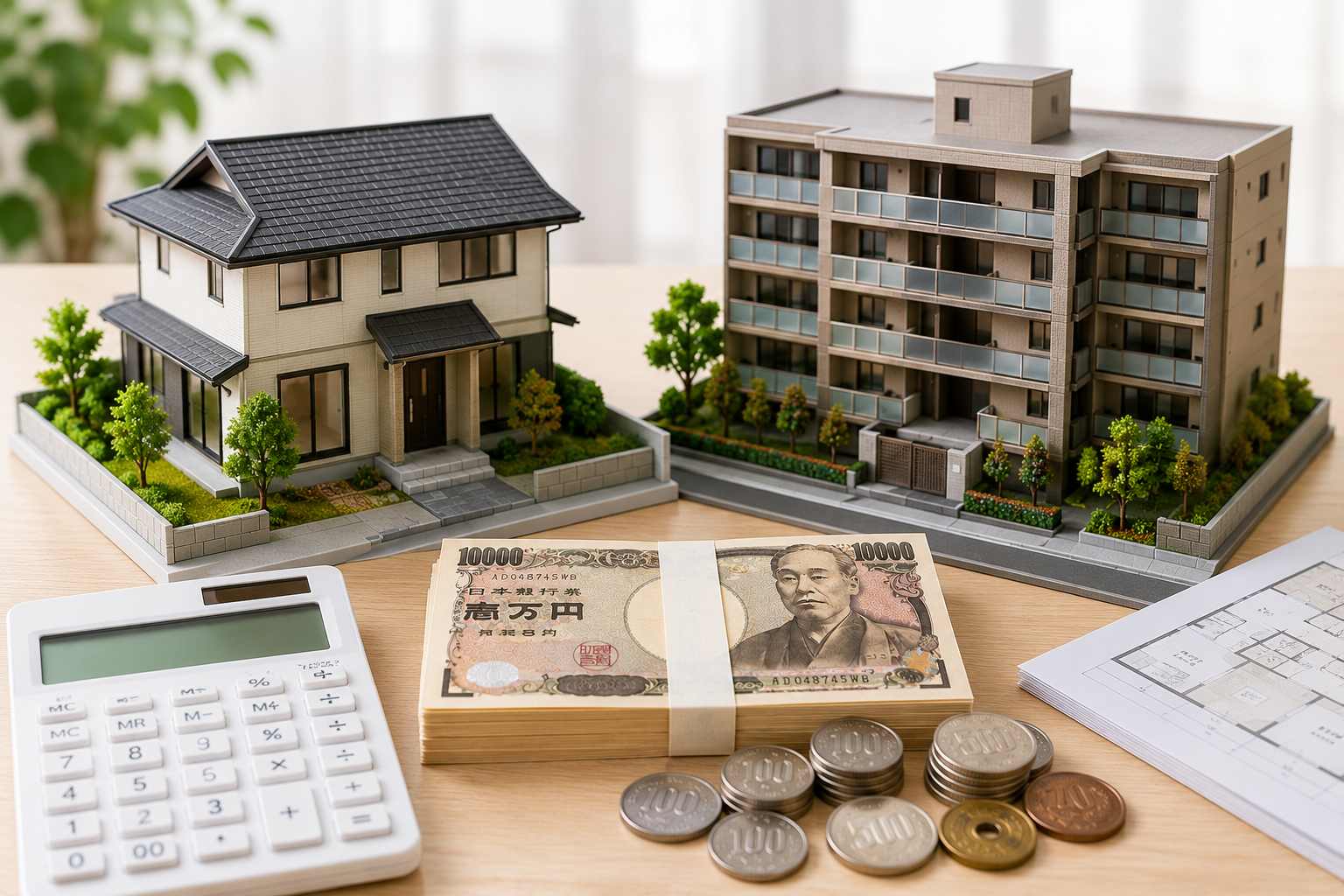
Should You Buy a Mansion (Condo) or a Kodate (Detached House) in Japan?This is a question almost everyone asks when they start researching home buying in Japan: should you choose a Mansion (マンション - condo) or a Kodate (一戸建て - detached house)?Many people believe that condos hold their value better than detached houses, but in reality this isn't always true. Value retention depends heavily on location, surrounding infrastructure, and many other factors. If both are in the same good area, Mansion and Kodate each have their own advantages and disadvantages — neither is universally superior to the other.In this article, ESTATE PLUS will walk you through a detailed analysis of the three most important factors: management costs, appreciation potential, and privacy — so you can get a comprehensive overview and make the choice that best fits your home-ownership goals.1. Management Costs1.1. Mansion: Management costs continue throughout the entire period of ownershipWhen you own a Mansion, you need to pay a monthly management fee (管理費) and a repair reserve fund (修繕積立金), typically ranging from about 10,000~40,000 yen/month.An important point to note: this is a cost that continues for as long as you own the unit — it is not a one-time expense. In other words, even after you've fully paid off your bank loan, you'll still need to keep paying the monthly management fee until you no longer own the property.Additionally, if you own a car and need to rent a parking space within the condo complex, you'll need to pay an extra parking fee, usually around 15,000~30,000 yen/month.1.2. Kodate: No monthly management fee, but maintenance requires self-initiativeWith a Kodate, you won't have to pay a monthly management fee like with a Mansion. However, this doesn't mean there are no costs at all — homeowners need to independently set aside maintenance funds as needed, typically at the 5-year, 10-year, and 15-year milestones.This reflects an important difference in ownership mindset: with a Kodate, maintenance costs aren't fixed on a monthly basis but depend on how proactive the homeowner is. The better and more timely your maintenance, the better the resale liquidity of the house will be in the future.2. Appreciation Potential2.1. Mansion: Easier to retain value in a good locationCondos tend to hold their value better if the unit is located near a train station, close to the city center, and in an area with high demand for renting or buying. Convenient access for commuting is always the biggest factor determining a condo's value retention.2.2. Kodate: Building value decreases over time, but land value may increaseWith a Kodate, the value of the building structure itself typically decreases over time due to physical wear and tear. However, the value of the land the house sits on may increase if it's in a desirable location, especially in areas undergoing infrastructure development.Over the long term, land is generally considered a more durable asset than the building structure, since land doesn't depreciate over time the way a building does.3. Privacy3.1. Mansion: Convenient, but more bound by shared regulationsLiving in a Mansion means you'll have neighbors right next to you, above you, and below you. This means your household is more likely to receive complaints from neighbors about noise — such as children playing, karaoke singing, or parties.Mansions also come with other restrictions worth noting:•        You must comply with the management association's rules•        Restrictions on renovations or interior modifications (especially changes related to shared structural elements)•        Many condo buildings don't allow dogs, cats, or other pets3.2. Kodate: More private and flexible living spaceIn contrast, a Kodate offers a much more private living space. You can freely renovate and modify the house as you wish without needing approval from a management association, and you're also less affected by surrounding neighbors.Overview Comparison Table: Mansion vs. KodateCriteriaMansion (Condo)Kodate (Detached House)Monthly management feeYes - 10,000~40,000 yen/month + parking fee 15,000~30,000 yen/month (if applicable), ongoing for as long as you own the unitNo fixed monthly fee, but you must independently set aside maintenance funds on a 5/10/15-year cycleValue retentionGood if near a train station, city center, or high-demand areaBuilding value decreases over time, but land value may increase if well locatedPrivacyMore limited: noise issues with neighbors, subject to management association rules, often no pets allowedHigher: freedom to renovate, less affected by neighborsBest suited forThose who prioritize convenience and don't want to handle maintenance themselvesThose who want long-term cost savings, land ownership, and private living space4. Advice: So Should You Choose a Mansion or a Kodate?There's no single right answer for everyone, because the best choice depends on each individual's lifestyle goals and financial objectives:•        If you prioritize convenience and don't want to handle maintenance and repairs yourself, a Mansion is the more suitable choice.•        If you want long-term cost savings, to own land as a durable asset, and to have a private living space you can freely renovate, a Kodate is worth serious consideration.Conclusion: Don't Just Look at the Sale PriceWhen buying a house in Japan, don't compare Mansion and Kodate based on the initial sale price alone. Compare the total cost of ownership over 20~30 years — including management fees, maintenance costs, value retention, and how well it fits your lifestyle. This is what truly determines whether your real estate investment will be effective in the long run.Each type of housing has its own strengths and weaknesses, and the right choice should always be considered based on your specific location, budget, and long-term life plans.👉 If you're weighing Mansion versus Kodate for a specific location, contact ESTATE PLUS to have our consulting team provide a detailed analysis of the total long-term cost of ownership, helping you make the most accurate decision for your finances.Note: The comparative information in this article is general and for reference purposes, based on common characteristics of the Japanese real estate market. Actual management fees, maintenance costs, and appreciation potential may vary depending on the specific building, area, and timing. For accurate advice tailored to your specific situation, please contact an ESTATE PLUS consultant directly.

Apr 14, 2026

Tokyo, Osaka, Nagoya, Fukuoka Housing Prices in 2026: How Much Longer Will They Keep Rising?

ESTATE PLUSUpdated 2026 property prices in Japan's four major cities: Tokyo, Osaka, Nagoya, and Fukuoka. An analysis of price trends and the risks to watchJapan's real estate market is going through its longest and strongest period of price growth in years. According to the Published Land Price (公示地価) announcement by Japan's Ministry of Land, Infrastructure, Transport and Tourism (MLIT) on January 1, 2026, the nationwide average land price rose for the 5th consecutive year, with residential land prices having risen continuously for 12 years.In this article, ESTATE PLUS will walk you through an updated overview of property prices in the country's four largest markets: Tokyo (23 central wards), Osaka, Nagoya, and Fukuoka — along with the factors shaping their growth potential going forward.1. Tokyo's 23 Wards: New Condo Prices Surpass 100 Million Yen, But Has Growth Cooled?Tokyo's 23 central wards remain Japan's hottest market. Residential land prices here rose by an average of +8.99% in the early-2026 announcement period, and notably, no ward saw a price decline — all 23 wards recorded positive growth.In terms of condo prices, the market hit a memorable milestone: the average sale price of new condos in the 23 wards surpassed 100 million yen and has remained above this threshold continuously since May 2024. Resale condos (previously owned units) have also accelerated, rising from around 50 million yen at the end of 2024 to nearly 80 million yen by November 2025.However, Q1 2026 data shows signs of cooling: the pace of price growth for resale condos in the 23 wards has slowed compared to previous quarters, ceding the lead in growth speed to the Osaka market. Still, in terms of cumulative price growth since initial sale, condos in the 23 wards recorded an average increase of up to +117.7% over their original launch price — the highest among Japan's major cities.Main drivers in Tokyo•        A decline in new condo supply has left the market short on inventory, while genuine demand remains strong thanks to buyers who can still afford homes under 100 million yen.•        Wariness toward older homes has also eased significantly: according to a survey by the National Real Estate Brokers Association, more than 54% of respondents said they no longer hesitate to buy a previously owned home if it's in good condition.2. Osaka: Price Growth Rate Surpasses Even Tokyo in Q1 2026If Tokyo holds the highest cumulative price increase, Osaka is the market with the fastest price growth rate in Q1 2026, overtaking Tokyo's 23 wards.Notable points in Osaka•        Resale condo prices across Osaka Prefecture have risen 66.3% compared to 9 years ago (as of January 2026), with an average unit price of about 520,000 yen/m².•        Kita-ku (北区) leads the 9-year growth with +132.4% — a figure approaching the growth rate of Minato-ku (港区), Tokyo's most expensive ward.•        Chuo-ku (中央区), which includes the Namba, Shinsaibashi, and Honmachi areas, ranks 2nd with growth of +90.9%.•        The “6 central wards” group (Kita, Chuo, Tennoji, Nishi, Fukushima, Naniwa) has notably higher unit prices than the overall average and faces less risk of price decline thanks to transit advantages and urban redevelopment projects.Compared to Tokyo, Osaka's population and economic scale aren't as large, but its price growth is closing the gap, reflecting capital shifting toward seeking better returns in Japan's second-largest metropolitan areas.3. Nagoya: Stable Growth, But Showing Signs of SlowingThe Nagoya metropolitan area (名古屋圏) is one of Japan's three major metropolitan areas (alongside Tokyo and Osaka), and continues to record land price growth for the 5th consecutive year. However, MLIT's 2026 land price report notes that growth momentum in this region has shown signs of slowing compared to the other two metropolitan areas.In Aichi Prefecture, the ward with the highest land prices is Nakamura-ku (中村区) in Nagoya, with growth of +4.70% year-on-year.In terms of condo prices, the Nagoya market shows stability rather than a boom: the average price of a resale condo (70m²) rose from about 20.59 million yen (2016) to 29.07 million yen (2025), equivalent to an average annual growth rate of about 5% over 10 years, with 2022 recording the sharpest single-year increase (nearly 2 million yen in just one year).Compared to Tokyo and Osaka, Nagoya is a market with a lower growth margin but also more stable and less prone to sudden corrections - well-suited to investors who prioritize safety.4. Fukuoka: A Market Driven by Population Growth, Not SpeculationFukuoka tells a different story from the other three cities: its growth momentum comes mainly from population growth, rather than speculative capital flows.Key figures in Fukuoka•        Residential land prices across Fukuoka Prefecture rose by an average of +3.7% in the Q1 2026 announcement, marking the 12th consecutive year of price growth. All of the nationwide top 10 locations with the highest residential land price growth rates are located within Fukuoka City.•        The strongest growth point was Ohori 1-chome in Chuo-ku, with an increase of +13.7%, which is also the location with the highest residential land price in the city.•        Resale condo prices in the 1~10 year age segment near train stations rose from about 39.26 million yen (2021) to 50.58 million yen (2024).According to several early-2026 market reports, the price growth rate of resale condos in Fukuoka in certain segments has even surpassed Tokyo's 23 wards - a notable fact given that home loan interest rates have been gradually rising under the Bank of Japan's (BOJ) monetary policy normalization.Why is Fukuoka “immune” to rising interest rates?Three factors are most frequently cited:•        Fukuoka is the designated city with the highest population growth rate in Japan, while condo supply - especially in convenient locations - hasn't kept pace with demand.•        Large-scale redevelopment projects such as “Tenjin Big Bang” and “Hakata Connected” are comprehensively upgrading the infrastructure and urban landscape of the city center.•        The luxury condo segment is booming, with a growing number of “Oku-mansion” projects (priced above 100 million yen), pulling the overall price level upward.5. Quick Comparison of the 4 MarketsCityKey HighlightsMain DriversRisk LevelTokyo 23 WardsNew condo prices have surpassed 100 million yen; highest cumulative price increase nationwideSupply shortage, strong genuine demand plus heavy investmentPrice growth is cooling; prices are already at a high levelOsakaQ1 2026 price growth rate surpassed even Tokyo; Kita-ku and Chuo-ku lead the wayUrban redevelopment, capital seeking better yields than TokyoRising quickly but still has a price gap compared to TokyoNagoyaStable growth, moderate price increasesPosition as the 3rd-largest metropolitan area, genuine demandGrowth momentum already showing signs of coolingFukuokaSome segments are rising faster than Tokyo; 12 consecutive years of price growthGenuine population growth, city-center redevelopmentPrice growth is built on a solid population base, but new supply needs monitoring6. Overall AssessmentLooking at the bigger picture, the residential real estate market in Japan's four major cities remains on an upward trend, but the story differs in each location:•        Tokyo remains the market with the highest absolute value and the best liquidity, but its growth pace is no longer as hot as during the 2023-2025 period.•        Osaka is emerging as an attractive destination for capital seeking a faster growth rate than Tokyo, with a lower initial investment.•        Nagoya suits a cautious investment strategy that prioritizes stability over sudden gains.•        Fukuoka has the most solid growth foundation in terms of population increase, with less dependence on short-term speculative factors.As the BOJ continues its trend of raising interest rates, the key variable to watch closely going forward is the market's absorption capacity as borrowing costs gradually rise - especially in Tokyo, where home prices are already at record-high levels.Conclusion: Understanding the Trends Correctly to Invest at the Right TimeEach market - Tokyo, Osaka, Nagoya, and Fukuoka - is operating under different growth drivers, ranging from supply shortages and shifting capital flows to genuine population growth. Understanding the forces behind each price increase will help you accurately assess the potential and risks before making an investment or home-buying decision.👉 If you're interested in investment opportunities or buying a home in one of these four markets, contact ESTATE PLUS to have our consulting team provide the latest data and an analysis tailored to your financial goals.This article was compiled from the following sources: Japan's Ministry of Land, Infrastructure, Transport and Tourism (MLIT), the Haseko Research Institute (長谷工総合研究所), Mercury Corporation (マーキュリー), Mansion Navi (マンションナビ), Nikkei, and various regional real estate market reports. Data updated through April 2026. Market prices are subject to change; please refer to official sources for further information before making investment decisions.

Apr 14, 2026

How Do the Yen Exchange Rate and BOJ Interest Rates Affect Home-Buying Sentiment?

ESTATE PLUSHow Do the Yen Exchange Rate and BOJ Interest Rates Affect Foreign Buyers' Home-Purchasing Sentiment in Japan?The two factors currently exerting the strongest influence on the sentiment of foreign homebuyers in Japan are the yen exchange rate and the policy interest rate set by the Bank of Japan (BOJ). These two factors are pulling in opposite directions, making market sentiment far more complex than the common assumption that “a weak yen means foreigners buy more, a strong yen means they buy less.”In this article, ESTATE PLUS will analyze in detail the mechanism behind each factor's impact, based on official data from MLIT and major Japanese financial institutions, so you can have a clearer picture when considering buying a home or investing in real estate in Japan during the current period.1. The Context: Where Is the Yen, and Where Are Interest Rates?As of mid-2026, two important policy developments are unfolding in parallel:1.1. Interest rates hit a 31-year highOn June 16, 2026, the BOJ decided to raise its policy rate from 0.75% to around 1.0% — the highest level in 31 years (since 1995). This marks the 5th rate hike since the BOJ exited its negative interest rate policy in March 2024.Many banks are expected to raise their floating-rate home loan base rate by about 0.25% per year in October 2026, and some financial institutions forecast the policy rate could reach 1.0~1.5% during 2026.1.2. The yen is fluctuating sharply but remains in historically weak territoryThe USD/JPY foreign exchange market fluctuated quite sharply in the first half of 2026, at one point surpassing 159 yen/USD early in the year before adjusting back to the 152-157 yen/USD range.Year-end 2026 forecasts from major Japanese financial institutions are fairly dispersed:•        Nomura Securities: forecasts 152.5 yen/USD (revised upward from 147.5 yen due to Middle East geopolitical tensions)•        SMBC Nikko Asset Management: forecasts 150 yen/USD•        Daiwa Asset Management: forecasts the yen could strengthen to as much as 146 yen/USD by year-endOverall, analysts generally agree that the yen remains in historically weak territory compared to the pre-2022 period, even though the medium-term trend may be gradually shifting toward a stronger yen.2. A Weak Yen: A Positive Effect on Foreign Buyers' Home-Buying SentimentWhen converted into strong foreign currencies (USD, EUR, TWD, SGD, etc.), a weak yen makes Japanese real estate “relatively cheap” in the eyes of international buyers — this is the clearest mechanism of impact and is confirmed by many sources.Quantitative data from MLITAreaForeign Buyer Ratio, H1 2025Same Period 2024Tokyo Metro Area (東京圏)1.9%1.0%Tokyo (entire prefecture)3.0%1.5%Tokyo 23 Wards3.5%1.6%Tokyo's 6 Central Wards*7.5%3.2%Osaka (city)4.3%5.1%Nagoya (city)0.4%0.6%*Tokyo's 6 central wards include: Chiyoda, Chuo, Minato, Shinjuku, Bunkyo, and Shibuya.A few notable points from this data itself•        The ratio has more than doubled in most areas compared to 2024, reflecting an ongoing upward trend that coincides with the period when the yen has remained weak.•        Shinjuku Ward has the highest ratio in Tokyo: 14.6%.•        Among the 308 condo units purchased by foreigners in Tokyo's 23 wards (H1 2025), Taiwan accounted for over 60% (192 units), mainland China ranked only 2nd with 30 units, and Singapore ranked 3rd with 21 units. This contrasts with the common media narrative that “Chinese buyers are snapping up properties” — official data shows that Taiwan is actually the largest group by share in Tokyo.•        Osaka saw its foreign buyer ratio decline from 5.1% (2024) to 4.3% (H1 2025), moving in the opposite direction to Tokyo's rising trend, showing that the impact of a weak yen is not uniform across cities.The “double discount” psychological mechanismFor buyers using strong foreign currencies, a weak yen creates a “double discount” effect: even as the yen-denominated price of a home rises, that increase can be offset or outweighed by the yen's depreciation, meaning the price converted into foreign currency remains cheaper than, or comparable to, a few years ago. This is the logic frequently cited by brokerage firms and institutions when explaining why foreign capital flowing into Japanese real estate has remained strong even as yen-denominated prices have risen sharply.3. Rising Interest Rates: Different Effects on Loan Buyers vs. Cash BuyersThe impact of BOJ interest rates on foreign buyers depends heavily on whether they are borrowing within Japan or not.3.1. The group buying with domestic Japanese loansThis is typically made up of foreigners with long-term residency visas and income earned in Japan — the group directly affected by rising interest rates.According to banking sources, the average floating loan rate at major banks (mega banks) surpassed 1% per year in April 2026 — the highest level in around 15 years. Long-term fixed loan rates (e.g., Flat 35) have also risen from around 2% to roughly 3%, according to some early-2026 forecasts.For this group, rising borrowing costs reduce affordability and may make home-buying sentiment more cautious — similar to the impact felt by Japanese homebuyers.3.2. The group buying with cash or capital from abroadThis group is more common among international investors purchasing high-end properties in central areas, and is less affected by Japan's domestic interest rates, since their investment decisions don't depend on the cost of domestic borrowing.Foreign capital inflows into Japanese real estate in 2025 remained at an estimated scale of around 6 trillion yen, with no sign of foreign investors becoming more cautious despite rising interest rates.In other words: rising BOJ interest rates create downward pressure on home-buying sentiment among foreigners who are settling in Japan or borrowing domestically, but the effect is much weaker, or nearly absent, among international investors buying with cash — a group that holds a significant share of the high-end condo segment in central Tokyo and Osaka.4. When the Two Forces Intersect: Which Scenario Is Most Favorable/Unfavorable?Combining these two variables, we can outline 4 possible cases:CaseYenInterest RateImpact on Home-Buying Sentiment1WeakLowMost favorable: cheaper converted price + low borrowing cost. This was the backdrop for most of the 2022-2024 period.2WeakHigh (current, 2026)Mixed: cash buyers remain favored thanks to the weak yen; buyers relying on domestic loans face a double squeeze (rising home prices + rising borrowing costs).3StrongLowConverted price is less attractive, but low borrowing costs may still attract buyers looking to live there or settle, rather than speculate.4StrongHighMost unfavorable for both groups; current forecasts suggest this scenario is unlikely to occur in the short term.Japan is currently in Case 2: the yen is weak, but interest rates have risen to their highest level in 31 years. This may help explain why the ratio of foreign buyers purchasing homes in Tokyo's 23 wards continues to rise (according to MLIT's H1 2025 data) even as the pace of condo price growth in that same area shows signs of slowing.In other words, foreign capital is still flowing in, but the momentum is increasingly shifting toward cash buyers who are less sensitive to interest rates, while buyers who need financing (including Japanese buyers) are becoming more cautious.Conclusion: Two Variables to Watch in the Second Half of 2026A weak yen and rising BOJ interest rates are simultaneously affecting foreign buyers' home-purchasing sentiment in Japan, but in opposite directions. Official MLIT data shows that the ratio of foreigners buying new condos in central Tokyo areas is rising noticeably, with Taiwan — not China — being the nationality group with the largest share.For foreign buyers or investors considering the Japanese market, two points worth monitoring in the second half of 2026 are:•        Whether the BOJ will continue raising interest rates along the path forecast by financial institutions.•        Whether the yen will continue to stay weak or begin a strengthening trend, as suggested by some of Nomura's and Daiwa Asset Management's forecasts for the end of 2026.If both variables reverse at the same time (a stronger yen combined with continued rate hikes), this would be the most unfavorable scenario for foreign home-buying sentiment since the 2022 period.👉 If you're considering the timing for buying a home or investing in real estate in Japan, contact ESTATE PLUS to have our consulting team provide the latest updates on exchange rates and interest rates, along with an analysis tailored to your specific financial goals.This article was compiled from the following sources: Japan's Ministry of Land, Infrastructure, Transport and Tourism (MLIT – survey published November 25, 2025), the Bank of Japan (BOJ), nippon.com, Nomura Securities, Daiwa Asset Management, SMBC Nikko Asset Management, JLL, and several banking/real estate brokerage industry sources (mogecheck.jp, finwell.jp, 住まいサーフィン). Data updated through June 2026. The exchange rate and interest rate forecasts mentioned in this article represent the views of individual institutions at the time of publication, are subject to change, and do not constitute investment advice. This article is a compilation of reference information; please verify the original sources and consult a financial/legal professional before making any decisions.

Apr 14, 2026

Foreigners Selling Property in Japan After Returning to Their Home Country: A Detailed Guide

ESTATE PLUSAre Foreigners Free to Sell Property in Japan?Yes, absolutely. Japanese law does not restrict foreigners' rights to own or transfer real estate, regardless of whether you're currently in Japan or have returned to your home country, and regardless of whether your visa is still valid or has expired. Ownership rights are protected through registration at the Legal Affairs Bureau (法務局 - Houmukyoku) and are not tied to residency status.However, the real difficulty lies in the practical procedures: signing contracts, notarization, paying taxes, and making cross-border transfers all require either your physical presence or valid power of attorney. If you've already returned home, preparing things before leaving Japan will save you a great deal of time and money.🔑 Key point to remember:Selling a house after returning to your home country is entirely feasible, but you'll need a representative (代理人) in Japan with valid power of attorney. Setting up the power of attorney before leaving Japan is far simpler than doing it from Vietnam through the embassy.Step 1: Preparing Before You Return HomeThis is the most important stage. The more thoroughly you prepare before leaving Japan, the less likely you'll need to fly back or deal with complicated procedures through the embassy.1.1. Set up a notarized power of attorney (委任状)This is the most important document, allowing your representative in Japan to sign contracts and carry out all procedures on your behalf. The power of attorney must be notarized (公証役場) in Japan, or at a Japanese embassy or consulate in your home country.It's best to do this before leaving Japan, since the process is much faster in Japan (1~2 days) compared to going through the embassy (1~3 weeks, sometimes requiring certified translation).1.2. Gather all property documentsCollect all original documents: the certificate of ownership (登記済権利証 or 登記識別情報), the original purchase contract, property records, and floor plans. These documents are difficult or impossible to recover if lost.1.3. Open or maintain a Japanese bank accountThe sale proceeds will first be transferred into a Japanese account before being sent abroad. Accounts at major banks such as MUFG or SMBC are easier to receive funds into. Confirm with your bank about the procedure and fees for transferring money overseas before you leave.1.4. Choose a real estate brokerage (不動産会社)Contact a brokerage while you're still in Japan so you can meet in person, review the contract, and confirm details. Prioritize a firm with experience selling property on behalf of non-resident owners (非居住者).💡 Important tip:If you haven't decided on a sale price yet, request a valuation (査定) from a brokerage. This service is completely free and gives you a realistic basis for setting your listing price.Step 2: Required DocumentsBelow is a list of documents typically required for a property sale transaction in Japan.DocumentJapanese TermNotesCertificate of Ownership登記済権利証 / 登記識別情報Mandatory. If lost, an expensive replacement procedure is required at the Legal Affairs BureauPassport (original or copy)パスポートConfirms the owner's identityNotarized Power of Attorney委任状(公証済)Required if selling through a representative. Must be notarized in Japan or at a Japanese embassyOriginal Purchase Contract売買契約書(購入時)Needed to calculate capital gains tax. If lost, bank statements may be used insteadProperty Documents確認済証・確認申請書・間取り図・建物図面Helps the listing sell more effectively. Brokerages usually keep copies on fileBank Account Information振込先口座情報The account in Japan that will receive the sale proceeds. Needed before the handover date⚠️ If you've already returned home without power of attorney:You can set one up at the Japanese Embassy in Hanoi or Ho Chi Minh City, after which it will need consular legalization (アポスティーユ) and a certified Japanese translation. This process takes 3-6 weeks and costs around 300,000-500,000 VND. It's much better to handle this before leaving Japan.Step 3: Taxes & FinancesThis is the part many people overlook and are caught off guard by. In Japan, capital gains tax on real estate sales (譲渡所得税) can take a significant cut if the property has appreciated, and special rules apply differently to non-residents (非居住者).Tax TypeRateApplicable ConditionsShort-term capital gains tax (短期譲渡所得税)39.63%Owned for less than 5 years as of January 1 of the sale yearLong-term capital gains tax (長期譲渡所得税)20.315%Owned for 5 years or moreWithholding tax at source (源泉徴収)10.21%Mandatory for non-residents. The buyer withholds this amount before paymentBrokerage fee (仲介手数料)Up to 3% + 60,000 yenPaid to the brokerage firm (both seller and buyer pay this)3.1. The 10.21% withholding tax — a special point for foreignersIf you are a non-resident of Japan (非居住者), the buyer is legally obligated to withhold 10.21% of the sale price and remit it to the Japanese tax office on your behalf. This is not the final tax amount, only a provisional payment. You must still file a tax return (確定申告) in February~March of the following year to settle the final amount and claim a refund if you overpaid.3.2. An important exception: exemption from the 10.21% withholdingIf the sale price is under 100 million yen and the buyer will use the property as their actual residence (not as an investment), the 10.21% withholding may be exempted. Confirm this clearly with your brokerage, as it directly affects the cash flow you'll receive.3.3. The 30-million-yen tax exemption for a primary residenceIf you lived in and used the property as your primary residence (居住用財産), you may qualify for a special deduction of 30 million yen (3,000万円特別控除) against your taxable capital gain. Conditions: you must file within 3 years of moving out and report accurately. Many people miss out on this very significant benefit simply because they aren't aware of it.✅ Tax recommendation:Hire a tax accountant (税理士) experienced with real estate transactions involving non-residents. The cost is around 100,000~300,000 yen, but it can help you save millions of yen through tax optimization and avoid costly filing mistakes.Step 4: Selling RemotelyOnce you have valid power of attorney and complete documentation, most of the process can be handled remotely via email, Zalo/LINE, electronic signatures, or postal mail.1.        Sign the brokerage agreement remotely: The brokerage agreement (媒介契約) can be signed via email, with the original sent by EMS/DHL. It's best to choose an exclusive agreement (専任媒介, working with a single firm) rather than a non-exclusive one (一般媒介, multiple firms selling simultaneously), so the firm has a stronger incentive to sell actively.2.      Track progress via email/LINE: Real estate firms in Japan are accustomed to providing periodic reports (業務報告) to absent owners. Request a written report every 2 weeks, including the number of viewings, feedback received, and any suggested price adjustments.3.      Sign the sale contract (売買契約): This is the most critical step, typically requiring a signature and personal seal (印鑑) in person. If you have a valid representative, they can sign on your behalf. Otherwise, you'll need to send documents via international mail with signature verification at the embassy. Some brokerages offer electronic signing, but this isn't yet widely available in Japan.4.      Handover and payment (引き渡し・決済): Your representative carries out the key handover and receives the funds into your Japanese bank account. You then arrange to transfer the money to Vietnam through your bank, using the sale contract as supporting documentation.5.      Tax filing and refund (確定申告): Even after returning home, you must still file a tax return in Japan in February~March of the following year. You can have a 税理士 file on your behalf. If the 10.21% withholding exceeds the actual tax owed, you'll receive a refund into your Japanese account — remember to keep that account active until then.Step 5: Transferring Money Back HomeOnce the funds are in your Japanese account, you have several options for transferring them to Vietnam. Each option has different trade-offs in terms of exchange rate, fees, and processing time.MethodEstimated FeeTimeBest ForSWIFT wire transfer via a Japanese bank2,500~5,000 yen/transfer + exchange rate margin2-5 business daysLarge amountsWise / Revolut0.4~1% of total amount1-2 daysSaving on feesWestern Union / MoneyGramHigher feesFastNot recommended for large amounts📋 Documentation needed for large transfers:For amounts of several tens of millions of yen or more, Japanese banks will require documentation proving the source of funds: the sale contract, tax receipts, and sometimes confirmation from the tax office. Preparing this documentation in advance will help you avoid having funds held or your account frozen. The receiving bank in Vietnam may also ask about the source of the incoming foreign currency.Practical Summary: Complete Checklist for Sellers Returning Home✅ Before leaving Japan☐  Set up a notarized power of attorney for your representative in Japan☐  Gather all property documents into one envelope☐  Request a valuation from a real estate brokerage☐  Keep your Japanese bank account active (don't close it right away when you leave)☐  Ask your bank about the overseas transfer procedure and fees☐  Consult a 税理士 about the specific tax obligations for your situation✅ During the sale process (from Vietnam)☐  Maintain regular communication with the brokerage via email/LINE☐  Request a written progress report every 2 weeks☐  Monitor the market to consider timely price adjustments☐  Have documentation ready to send promptly when signatures are requested✅ After the sale is complete☐  Have a 税理士 file your tax return (確定申告) in February-March of the following year☐  Track any tax refund (if applicable) to your Japanese account☐  Prepare documentation on the source of funds for the transfer to Vietnam☐  Keep all transaction records for at least 7 years (a Japanese legal requirement)Conclusion: Selling Remotely Is Difficult, But Entirely FeasibleSelling a house in Japan after returning home is not simple, but thousands of foreigners do it successfully every year. The key lies in preparation: a notarized power of attorney, complete property documents, a reputable brokerage, and a knowledgeable 税理士 are all essential.If you're preparing to return home, set aside at least 1~2 months at the end of your time in Japan to handle all the legal paperwork. That time will help you avoid many costly headaches later on, including having to fly back to Japan just to sign a single document.The average time to sell a property in Japan's current market is 3~6 months for condos in major cities and 6~12 months for detached houses in suburban areas. Prepare yourself mentally to wait, and avoid dropping the price too quickly during the first month of listing.👉 If you're preparing to return home and need to sell your property in Japan, contact ESTATE PLUS now to get support preparing your power of attorney and documentation, and to be connected with brokers and tax accountants experienced in non-resident transactions — helping your remote sale go as smoothly and safely as possible.This article is for informational purposes only. Japanese tax laws and real estate regulations are subject to change. Please consult a legal and tax professional before proceeding with any transaction.

Apr 14, 2026

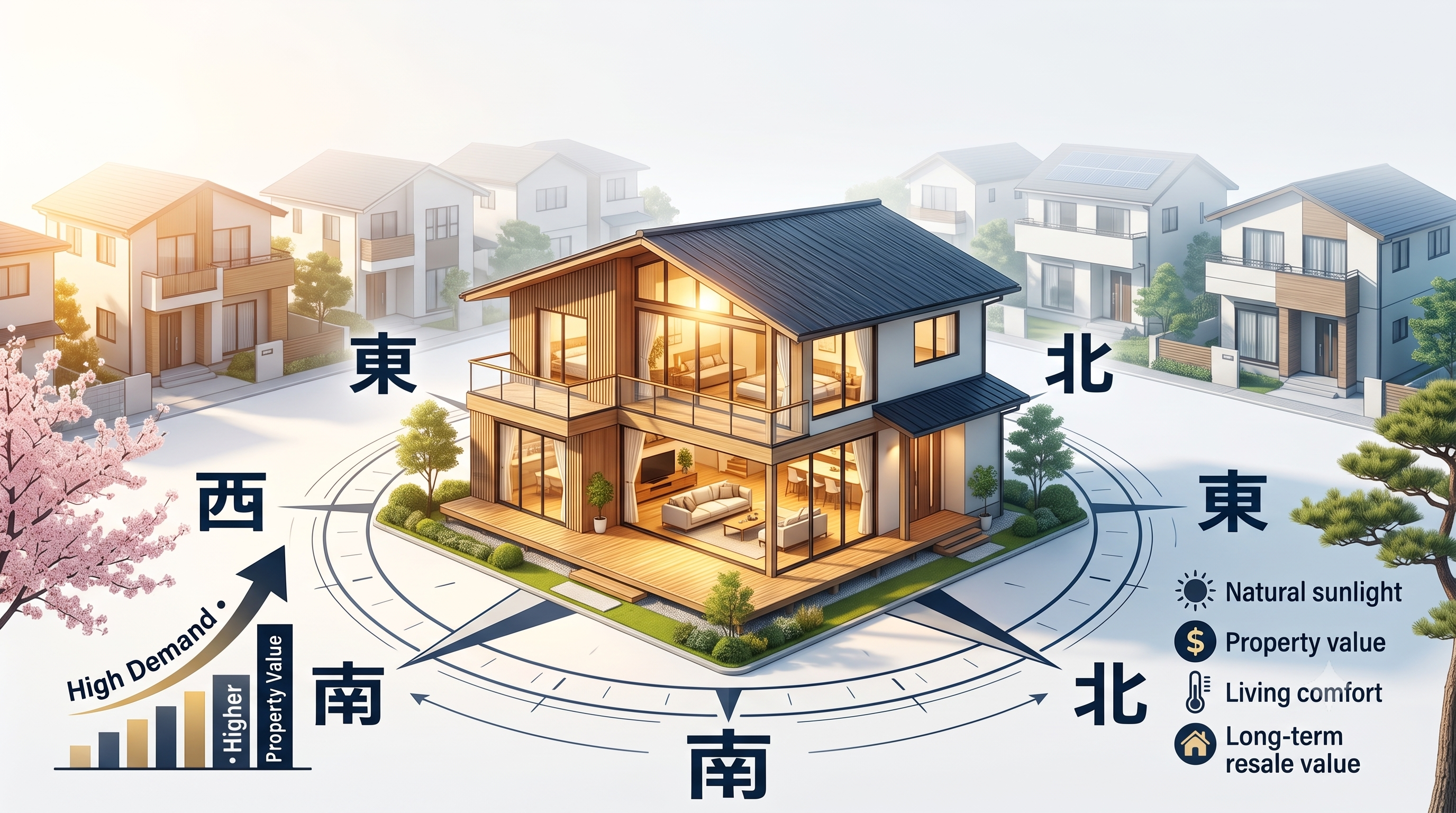
Which Direction Is Best for a House in Japan? Why South-Facing Properties Are Always the Most Expensive

Which Direction Is Best for a House in Japan? Why South-Facing Properties Are Always the Most ExpensiveA comprehensive analysis of house orientation by Japanese standards — from natural light and real-world value to practical advice for buyers.RankDirectionRatingPrice Level#1南 SouthBESTHighest#2東 EastVERY GOODHigh#3西 WestFAIRLY GOODAverage#4北 NorthLESS PREFERREDLowest1. How Much Do the Japanese Value House Orientation?In Japan, a property's orientation (向き - muki) is one of the top criteria when buying real estate, and is even clearly listed on property information sheets (物件概要 - bukken gaiyo) right below the floor area and sale price. It's no coincidence that south-facing homes are consistently listed at 5~15% higher prices than otherwise identical properties facing a different direction.The reason isn't feng shui or superstition, but rather climate realities and the distinctive way Japanese homes are built, where natural sunlight is treated as a valuable resource for both health and electricity bills.☀️ The basic reason:Japan is located in the Northern Hemisphere, so the sun moves toward the south throughout the day. A home facing south will receive the most direct sunlight — this is the foundation of the entire preference hierarchy for house orientation.2. Why Are South-Facing Homes Always the Most Expensive?The answer lies in 4 specific benefits that south-facing orientation provides, which the Japanese quantify very clearly:2.1. Natural light throughout the dayThe living room and main living space (リビング) are typically placed on the south side to capture sunlight from morning to evening. Children doing homework, adults reading, the whole family having breakfast — all bathed in abundant natural light without needing to turn on the lights. This is a genuine practical benefit, not just a subjective preference.2.2. Warmer winters, lower heating costsJapan's winters are long, especially in Tokyo, Osaka, Nagoya, and the northern regions. South-facing sunlight entering through large sliding glass doors (掃き出し窓) naturally raises room temperature by 2~4°C — a figure that may seem small but adds up to significant savings on annual electricity bills.2.3. Laundry drying — a daily necessity for Japanese householdsThe culture of outdoor laundry drying (外干し) remains very common in Japan. A south-facing balcony means laundry dries faster and with less musty odor — something many Japanese households consider a must-have condition when choosing a home.2.4. Higher resale valueBecause the market broadly agrees that south is the best orientation, south-facing homes retain their value better when resold. This is a real financial advantage, especially if you plan to live there for 5~10 years before selling.📊 Actual price difference:According to surveys of major Japanese real estate platforms (SUUMO, AtHome), south-facing condos in Tokyo and Osaka are typically priced 8%~18% higher than north-facing units on the same floor with the same floor area, depending on the area.3. Detailed Comparison Table: South - East - West - NorthDirectionSunlightWinter Temp.Laundry DryingRelative PriceSouth (南向き)All dayWarmestBestHighestEast (東向き)MorningFairly warmGoodHighWest (西向き)AfternoonAverageFairAverageNorth (北向き)Almost noneColdestPoorLowest4. East-Facing: The 2nd Most Popular ChoiceMany young families prefer east-facing homes because morning sunlight is generally gentler than afternoon sun, which fits well with an early-morning work schedule. An east-facing bedroom makes waking up feel more natural and pleasant.5. West-Facing: Watch Out for Afternoon SunWest-facing homes receive afternoon sunlight, which tends to be hotter and harsher than morning sun from the east or all-day sun from the south. In summer, west-facing rooms can get very hot between 2pm and 6pm and require good blackout curtains or near-constant air conditioning. This is why west-facing homes are less preferred than east-facing ones, even though both receive sunlight for only part of the day.6. Should You Buy a North-Facing Home to Save Money?This is the most practical question of all, and the answer is: it depends on your circumstances. A north-facing home isn't a bad choice for everyone, but you need to clearly understand the trade-offs involved.✅ PROS OF NORTH-FACING⚠️ CONS OF NORTH-FACING• 8~18% lower purchase price• No direct sun, cooler in summer• Even, diffused light with less glare• Lower summer air-conditioning bills• Dark; lights needed during the day• Colder and more humid in winter• Laundry takes longer to dry, prone to musty odors• Higher risk of mold• Lower resale value6.1. When is north-facing a reasonable choice?North-facing may suit you if you:•        Work from home and need even, consistent lighting (photography, design, programming)•        Are frequently away from home during the day•        Prioritize summer coolness over winter warmth•        Live in a warmer climate region (Osaka, Fukuoka, Okinawa)•        Have a tight budget and want to own a home sooner6.2. North-facing may not suit you if you:•        Have young children or elderly family members who need warm sunlight•        Live in a cold region such as Sapporo, Sendai, or Tokyo in winter•        Regularly dry laundry on a balcony•        Have mold allergies or respiratory issues•        Plan to resell within 5~7 years7. A Practical Calculation: Savings or Extra Costs?Suppose a 60m² condo in Tokyo costs 50 million yen facing south, versus 43 million yen facing north (a 7-million-yen savings at purchase).However, you may spend an extra 30,000~60,000 yen per year on heating and lighting, plus the cost of dehumidifiers and moisture control. Over 20 years, this operating cost difference could add up to 1~1.2 million yen — still notably better value than choosing south if you don't plan to resell.8. Checklist for Viewing Homes in Japan by OrientationBeyond the property's main orientation, several other practical factors affect the actual quality of light you'll receive:•        View the property at midday: this is when the light difference between orientations is most apparent.•        Check the building across the street: a south-facing home blocked by a tall building can be worse than an unobstructed east-facing one.•        Check the floor level: a low floor (低層階), even if south-facing, can still be darker than a higher north-facing floor in a dense neighborhood.•        Ask about the surrounding zoning (用途地域): a pure residential zone (第一種低層住居専用地域) guarantees no tall buildings will be built nearby in the future.•        Check actual humidity levels: inspect wall corners and ceilings for signs of mold, especially for north-facing units.•        Check the balcony's position: a south-facing balcony that's too narrow or has a large overhang can also significantly reduce the light entering the home.Conclusion: Which Direction Should You Choose?If your budget allows: south-facing is always the safest choice — good for quality of life, easy to resell, and rated highest by the Japanese market. Southeast-facing is the ideal sweet spot if you want a balance between morning and midday sun.If your budget is limited: north-facing is a reasonable choice if you clearly understand its limitations and compensate with the right equipment (dehumidifiers, a good heating system, insulated curtains). Saving 7~10% on the purchase price is a real financial advantage, especially for young, first-time buyers.💡 Most important takeaway:The building across the street, the floor level, and the surrounding building density can sometimes affect the actual light you receive even more than the orientation itself. Always view a property during the daytime before deciding.👉 If you're viewing properties and aren't sure which orientation to prioritize based on your budget and lifestyle needs, contact ESTATE PLUS to have our consulting team assess each property realistically — not just based on the orientation listed on paper, but also the floor level, the building across the street, and the surrounding zoning.This article is for informational purposes only. Actual real estate prices may vary by area and market timing.

Apr 14, 2026

Bank Loans for Foreigners Buying a House in Japan: With and Without Permanent Residency

Bank Loan Conditions for Foreigners Buying a Home in Japan: With and Without Permanent ResidencyOwning a home in the land of the cherry blossoms is a major milestone that affirms the stability of life and career for Vietnamese people living in Japan. However, the cost of buying a home is far from small, and most of us need financial support from a bank. So how does the home-buying process in Japan actually work? How can you get approved for a Japanese bank loan at the most favorable interest rate?This article breaks down in detail the conditions for a home loan (住宅ローン) for two specific groups: those who already hold permanent residency, and those who don't.1. The Nature of Home Loans (住宅ローン) in JapanBefore getting into the details, you need to understand that Japanese banks are extremely cautious when disbursing loans. They don't just look at the value of the property — they also assess the level of risk and the borrower's long-term ability to repay. For foreigners in particular, the factor of “commitment to staying in Japan long-term” is always weighed heavily.2. Common Ground for All Borrowers at Japanese Banks: The “Unwritten Rules”Whether or not you hold permanent residency, to pass through the screening process at Japanese banks, you must satisfy the following baseline conditions:•        A clean tax payment history: You must provide a certificate of tax payment. Any history of late tax payments, tax evasion, or unpaid pension (Nenkin) contributions will result in immediate rejection of your application.•        Stable income and length of employment: Banks typically require that you've worked at your current company for at least 1 to 3 years (a small number of banks accept 6 months if the company is large). A stable income of at least 3 million yen or more.•        A “clean” credit history: You must have no record of bad debt, unpaid phone bills, or late credit card payments. If you've been late on credit card payments too many times, your credit score at CIC (the credit information center) will be negatively affected.•        Age requirements: Generally between 20 years old and under 65 at the time of borrowing, with the loan fully repaid before age 75 or 80.•        Health condition: You must be eligible to enroll in group credit life insurance, Danshin (団体信用生命保険) — a type of insurance that pays off the remaining loan on your behalf in the event of a major health issue or death.3. The Key Difference: Group WITH Permanent Residency vs. Group WITHOUT Permanent ResidencyThe decisive factor that creates a difference when borrowing from a Japanese bank is your visa status.3.1. The group WITH permanent residency: “The door is wide open”If you already hold a permanent residency card, congratulations! Essentially, your loan conditions and benefits are completely on par with those of a Japanese citizen.•        Maximum loan ratio: You can borrow up to 110% of the property value (including the costs of registration and other procedures).•        Preferential interest rates: You'll get the lowest rates available in the market (current floating rates start from as low as 0.9%, depending on the bank).•        A wide range of bank choices: You can freely apply to major banks (megabanks) such as MUFG, SMBC, and Mizuho, as well as online banks offering excellent rates such as SBI Shinsei and au Jibun Bank.3.2. The group WITHOUT permanent residency (engineer visas, business visas, highly skilled professional visas, etc.)Can you buy a home in Japan without permanent residency? The answer is YES, but the conditions are much stricter, since banks are concerned about the risk of you returning to your home country partway through the loan term.•        Down payment requirement (頭金): Most banks will require you to pay 10% to 20% of the property value upfront yourself. Very few banks lend 100% without permanent residency (currently SMBC and Suruga offer 100% financing).•        Limited number of lending banks: The number of banks that accept applications from non-permanent residents is fairly limited. Some familiar names that support this group include SMBC, MUFG, and Suruga.•        Requirement for a guarantor or marriage: Some banks will only approve an application if you have a Japanese spouse, or a spouse with permanent residency, acting as a guarantor (or co-borrowing through a “Pair Loan”).•        Higher interest rates: To offset the risk, the interest rates applied to non-permanent residents are usually higher than those for permanent residents (depending on the application).💡 A positive note:If your application is strong (high income, a large publicly listed employer, stable employment, a healthy account balance, etc.), you can still get 100% financing at rates comparable to those offered to Japanese citizens or permanent residents.4. Overview Comparison Table of Loan ConditionsComparison CriteriaGroup WITH Permanent ResidencyGroup WITHOUT Permanent ResidencyMaximum loan ratioUp to 110% (full loan amount + related costs)Typically only 80~90% (SMBC and Suruga offer 100% depending on the application)Average interest rateLowest available at current market ratesAverage to high (very strong applications may still get low rates)Bank optionsAll banks in JapanLimited (only a select number of designated banks)Employment requirements1~3 years at current companyGenerally stricter, with preference for large companies5. The Latest Updates to Japan's Land Law and Tax Policy (2026)If you're planning to go through the home-buying process in Japan this year, there are two important legal and tax updates you shouldn't overlook:5.1. Stricter requirements for registering inherited landUnder the latest law now in widespread effect, registering the transfer or inheritance of real estate has become mandatory. If you buy an older home or a plot of land without completing this registration clearly, you could face heavy administrative fines. This makes the market more transparent, but it also means legal document checks during a home purchase must be carried out with extreme care.5.2. Changes to the home loan tax deduction policy (住宅ローン控除)The income tax refund policy for home loan borrowers is still in effect, but the energy-efficiency standards required of a home have become stricter. The more environmentally friendly a home is, the higher the cap on the tax refund. Conversely, if you buy an older home that doesn't meet insulation standards, the amount of tax refunded will be significantly reduced.6. The Standard 5-Step Process for Applying for a Bank Loan and Successfully Buying a HomeTo make the approval process go smoothly, you should be familiar with the following roadmap:STEP 1Preliminary Screening (事前審査 - Jizen Shinsa)Done online or through a real estate agency to find out whether the bank is willing to lend to you. Timeframe: 3~7 days.STEP 2Find a Home and Sign the Sale Contract (売買契約)After passing the preliminary screening, you proceed to finalize the home you've chosen.STEP 3Formal Screening (本審査 - Hon Shinsa)The bank conducts a detailed appraisal of the property and a thorough review of your personal application. Timeframe: 1~2 weeks.STEP 4Sign the Loan Agreement (金錢消費貸借契約)Formally sign the agreement covering the interest rate terms and loan duration.STEP 5Disbursement and Handover (引き渡し)The bank transfers the funds to the seller, you receive the keys, and begin your journey of monthly repayments.ConclusionBuying a home in Japan isn't difficult if you clearly understand where your application stands and prepare a smart financial roadmap. Whether or not you hold permanent residency, the opportunity to own a home in Japan remains wide open, as long as you know how to choose the right bank and the right partner to guide you through the process.Not sure how much you can borrow based on your income? Struggling with translating your documentation for a Japanese bank?👉 Leave your contact information today or reach out to ESTATE PLUS to get free guidance from real estate experts who deeply understand the market and can help you map out your loan application journey!This article is for informational purposes only, compiled based on common regulations and loan conditions at Japanese banks. Actual conditions, loan ratios, and interest rates may vary depending on the bank, the timing, and the individual applicant. Please contact a bank directly or a consultant for accurate confirmation before making any decisions.

Apr 14, 2026

Free (0-Yen) Akiya Homes in Japan: The Truth and the Cost Traps You Need to Know

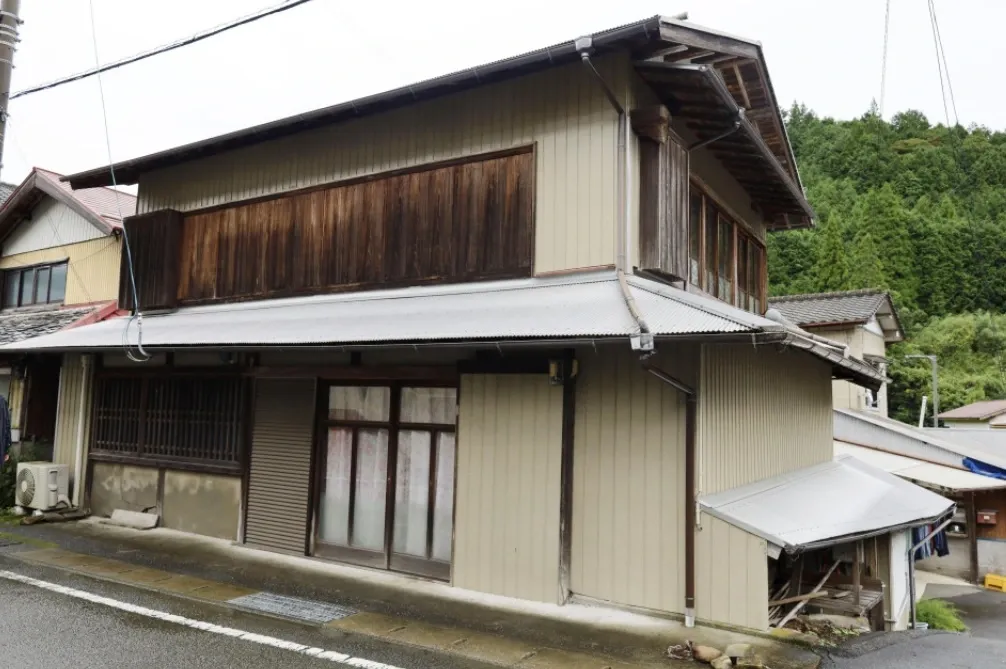
0-Yen Akiya Homes in Japan: The Bare Truth and the “Cost Traps” That Will Shatter Your DreamOwning a home in Japan for the price of a single meal - or even getting one “given away” for 0 yen - sounds like a joke, but it's a story that has been all over international media in recent years. Against the backdrop of skyrocketing property prices in major hubs like Tokyo and Osaka, the “buy a house in Japan for 0 yen” craze has become a lifeline for many Vietnamese people looking to save money, or for small-scale investors dreaming of renovating a property into a homestay for cash flow.However, there's no such thing as a free lunch in this world, and the 0-yen Akiya house is the most expensive “free” thing you've ever seen. This article will break down the full truth and the risks of buying an old home in Japan, so you don't end up losing money for nothing.1. Why Do These Abandoned 0-Yen Homes Exist in Japan?To avoid falling into the trap, you first need to understand the origin of Japan's abandoned homes (Akiya - 空き家). Japan is facing a serious aging population and demographic decline. When the older generation passes away, their children have usually already moved to major cities to build their careers and settle down.They have no desire to move back to their hometown to live, yet they're saddled with a massive financial burden from the inherited home. So their optimal solution is to list it for next to nothing - or even give it away for 0 yen to anyone willing to take over the title - just to “shed the burden.”2. The “Hidden Cost Traps” That Turn a 0-Yen Home Into an Expensive LiabilityMany people mistakenly believe that buying a 0-yen home just means packing your bags and moving in, or doing a bit of light touch-up painting. In reality, the amount you end up spending after signing the transfer contract can equal, or even exceed, the cost of buying a brand-new home.2.1. Sky-high renovation costsA defining feature of 0-yen Akiya homes is that they've been abandoned for years, sometimes even decades. The plumbing is rusted, the flooring is rotted from termite damage, the roof leaks, and - critically - the earthquake-resistant structure typically doesn't meet current standards.In Japan, labor and construction material costs are extremely high. Renovating a dilapidated abandoned home to a safe, livable standard - or to a standard suitable for a homestay - often costs anywhere from several million to tens of millions of yen. There have been plenty of cases of buyers left in tears after discovering their renovation costs were double the price of buying a brand-new plot of land.2.2. Demolition costs (Kaitai) and the fixed asset tax problemIf a house is too far gone to save, the only option is to demolish it and use the now-vacant land. Demolishing a wooden house in Japan typically costs 1 million yen or more, depending on the size and terrain of the property.⚠️ Important warning about land tax:In Japan, the government offers a land tax reduction of up to 83% (bringing the tax down to just 1/6) if there is a residential structure on the land - even if it's abandoned. If you hastily demolish the old house without an immediate plan to rebuild, the land will be reclassified as vacant land, and your fixed asset tax will automatically jump to 6 times its previous amount the following year.2.3. Taxes and transfer fees involved in the transactionEven though the purchase price is 0 yen, you'll still need to pay legal fees to the government calculated based on the property's assessed value (not the 0-yen transaction price):•        Registration tax for the certificate of ownership (Touki fee)•        Real estate acquisition tax•        Service fees for a lawyer to handle the title transfer procedures3. Legal Risks From Japan's Latest Land Registration LawIf you're thinking “I'll just buy it and fix it up whenever I have the money,” you'd be mistaken. Japanese law regarding abandoned properties is becoming increasingly strict in an effort to thoroughly address the Akiya problem.Many people assume that buying a 0-yen home means the title transfer process will be quick and simple. In reality, the biggest legal obstacle with Akiya homes lies in the ownership status of the seller (the previous owner).📌 An important legal change:In Japan, starting April 1, 2024, the revised Real Estate Registration Act (不動産登記法) began strictly enforcing a requirement that heirs must complete inheritance registration (相続登記) within 3 years of acquiring inheritance rights. This means that millions of abandoned homes from before 2024 are now effectively “ownerless” on paper.When you try to buy one of these 0-yen homes, you'll likely run into the following complications:•        Unable to locate the rightful owner to sign the contract: The home may be subject to inheritance claims from 3~4 children or grandchildren scattered across Japan. To complete the purchase, you'll need consent signatures from all of these individuals. Locating and persuading them to complete the inheritance registration process is extremely time-consuming and costly in legal fees.•        Inflated Touki (title transfer registration) costs: If the previous owner never completed the inheritance registration, you'll bear an additional service fee for a lawyer to untangle this paperwork before the title can officially be transferred to you.On top of that, if your Akiya home is classified by the local government as a “dangerous abandoned property” (due to risk of collapse, environmental contamination, or being an eyesore), you'll lose all tax incentive benefits and be forced to handle the situation entirely at your own expense.Summary Table: “Cost Traps” to Keep in MindType of Risk/CostLevel of ImpactRenovation/repair costsSeveral million to tens of millions of yenDemolition costs (Kaitai)1 million yen or moreFixed asset tax if demolished without immediate rebuildingIncreases up to 6x the following yearTransfer taxes and fees (Touki, etc.)Calculated based on the assessed value, not the 0-yen sale priceRisk of the previous owner not having registered inheritanceRequires consent signatures from multiple heirs, costly and time-consuming legally4. Advice: Should You Buy a Cheap Akiya Home?The answer is YES, BUT only if you truly understand the law and prepare thoroughly. To turn an Akiya home into a profitable investment or an affordable place to live, keep these principles in mind:• Location is everything: Avoid homes in remote areas with poor access to public transportation. Choose Akiya homes in the suburbs of major cities, or in areas with tourism potential if you're planning a homestay.•        Inspect the structural condition carefully before paying: Never buy a home based on photos alone. Hire a professional home inspector to visit in person, measure, and assess the level of deterioration to accurately estimate renovation costs.•     Carefully check the previous owner's tax debts: Make sure the property isn't subject to a dispute or under seizure due to the previous owner's unpaid taxes.Conclusion: Don't Let the “Cheap Price” Label Blind YouA 0-yen Akiya home in Japan isn't an easy slice of cake - it's a complex financial puzzle that requires buyers to keep a level head and have a deep understanding of local law. Don't let the “cheap price” label blind you into bringing home a liability that breeds debt.Have you found a cheap old home in Japan that you're eyeing, but you're worried about legal risks and hidden costs? Not sure how to check the home's history and accurately calculate renovation costs?👉 Contact ESTATE PLUS right away - our team of real estate experts with deep knowledge of Japanese law will help you appraise the documentation, inspect the property on-site, and guide you through every step of the process as safely as possible!This article is for informational purposes only, compiled based on common laws and practices in the Japanese real estate market. Actual costs (renovation, demolition, taxes, legal fees) may vary depending on the specific property, area, and timing. Please consult a legal expert, lawyer, or real estate advisor before deciding to purchase an Akiya home.

Apr 14, 2026

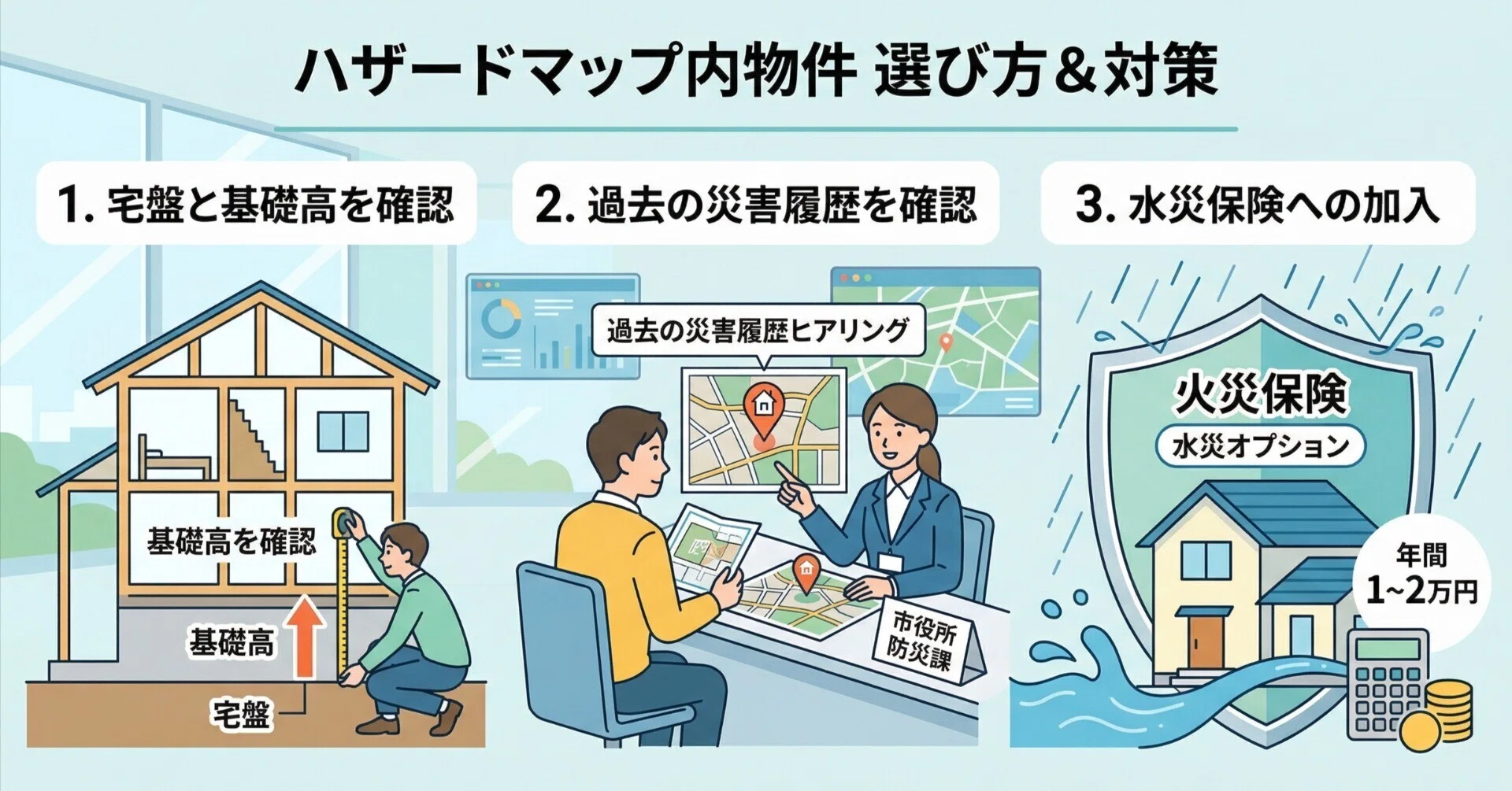
How to Check Disaster-Risk Areas (Hazard Map) Before Buying a House in Japan

How to Check Disaster Risk Areas Before Buying a Home in Japan: A Detailed Guide to Reading Hazard MapsJapan is renowned as a great place to live, with modern infrastructure, excellent safety, and a civilized environment. Yet there's one reality that anyone planning to settle here long-term must face: natural disasters. Earthquakes, flooding, landslides, and tsunamis aren't just things you see on TV — they're real risks that can directly impact a property worth tens of millions of yen and the safety of your family.Many Vietnamese homebuyers in Japan tend to focus only on design, distance to the train station, or price, while overlooking the geology and terrain of the surrounding area. Buying a home located in a flood-prone basin or on weak ground can turn your dream home into an enormous financial burden.📋 Legal regulation:Since August 2020, Japan's Ministry of Land, Infrastructure, Transport and Tourism has enacted a revised law requiring real estate agencies to explain disaster hazard maps as part of the mandatory disclosure of important matters (Juyo Jiko Setsumei - 重要事項説明) before a buyer signs the sale contract.However, rather than waiting until the moment you're about to sign to hear this explanation, proactively checking earthquake risk areas and avoiding flood-prone properties from the very start of your search will help you stay in control. This article will guide you through how to read Japan's disaster Hazard Maps in the clearest and most detailed way.1. What Is a Hazard Map (ハザードマップ)?A Hazard Map is a type of map that forecasts areas at risk of natural disasters, the estimated extent of damage (such as flood water depth or the scale of a potential landslide), as well as the locations of safe evacuation sites in the event of an emergency.These maps are built using scientific data, historical geological records, and simulations of the most severe disaster scenarios (for example, a 1-in-1,000-year record rainfall event). In Japan, every ward and city has its own Hazard Map for its area. Checking the Hazard Map is the first and most important screening step to eliminate properties located in dangerous “red zones.”2. A Step-by-Step Guide to Checking the Core Types of Disaster RiskWhen reviewing a disaster map, you need to pay particular attention to the following three major risk categories:2.1. Flooding (Shinsui - 浸水) and Tsunamis (Tsunami - 津波)When checking flood risk, the map will display color bands ranging from light to dark, corresponding to the expected water depth in the event of heavy rainfall causing a levee breach or river overflow.Flood DepthMap ColorLevel of ImpactUnder 0.5 metersLight yellowFlooding up to ankle or knee height; the 1st floor may still be safe, but the basement or low-lying belongings will be affected0.5 to 3.0 metersLight pink / OrangeFlooding up to the ceiling of the 1st floor. If you buy a 2-story home, you must evacuate to the 2nd floor when an alert is issuedOver 3.0 to 5.0 meters or moreRed / PurpleFlooding covers the entire 1st and 2nd floors. An extremely dangerous area — best to avoid buying property here entirely2.2. Landslides (Dosasaigai - 土砂災害)If you're considering a home in the suburbs, near hills or mountains, or on sloped terrain, be sure to carefully check the landslide warning zones (土砂災害警戒区域).Warning ColorDanger LevelYellow zoneAn area where a landslide could pose a risk to residents' livesRed zoneA particularly hazardous area, where landslide debris could completely destroy the structure of an ordinary wooden home2.3. Earthquakes (Jishin - 地震) and Soil Liquefaction (Ekijoukagenshou - 液状化現象)Beyond the intensity of earthquake shaking, there's a particularly frightening hidden risk that few foreigners are aware of: soil liquefaction.This phenomenon occurs when a strong earthquake strikes soft, sandy ground with a high water table (typically reclaimed land, areas near rivers or the coast, or former marshland that's been filled in). When the ground shakes, underground water is forced upward, turning what was once solid ground into a liquid, mud-like mixture. As a result, the entire foundation of a home can sink unevenly, tilt to one side, or collapse completely — even if the structural frame above is very sturdy.⚠️ Warning:When checking the map, areas displayed in dark red or orange for liquefaction risk (液状化の可能性が高い) are places you should immediately cross off your buying list — or be prepared to spend a substantial amount of money on specialized pile foundations to support the structure.3. Official Tools and Websites for Checking Hazard MapsTo check these risks yourself, you can use two completely free, highly accurate online tools provided directly by the Japanese government.3.1. The Portal Site of Japan's Ministry of Land, Infrastructure, Transport and Tourism (MLIT)The website is called the Hazard Map Portal Site (ハザードマップポータルサイト): https://disaportal.gsi.go.jp/This is a centralized portal containing all of Japan's disaster data. Here, you'll find two main options:1.        Overlapping Hazard Map (重ねるハザードマップ): This is the most excellent and user-friendly tool for foreigners. Simply enter the property's address into the search box, and the map will appear. You can toggle on/off the layers for each type of disaster — flooding (洪水), landslides (土砂災害), and tsunamis (津波) — all on the same interface for a comprehensive overview.2.      Local Hazard Map (わがまちハザードマップ): This option takes you directly to a detailed PDF map published by the local government of each ward or municipality. These files may include detailed guidance in English, along with specific evacuation locations within the area.3.2. Local geological information websitesIf you want to dig deeper into liquefaction risk or detailed earthquake shaking forecast maps down to the neighborhood level, you can search on Google using the following format:•        [Prefecture/City Name] + 液状化マップ (Liquefaction map)•        [Prefecture/City Name] + 地震ハザードマップ (Earthquake hazard map)For example, if you're buying a home in Tokyo, the Tokyo Metropolitan Government's website has a map that very clearly displays the risk level of each district based on its ancient geological structure.Conclusion: The Hazard Map — A Shield Protecting Your InvestmentUnderstanding and knowing how to read the Hazard Map is the strongest shield protecting your investment in Japan. A property priced 10% to 20% below market value may very well be hiding an unfavorable disaster profile, sitting in a red flood zone or an area with a high liquefaction risk.However, reading these specialized maps yourself, filled with complex Japanese terminology, can sometimes cause you to miss critical details — especially data about the historical geology of that specific plot of land.Found a home you love but aren't confident about the safety of the surrounding ground? Worried there might be unfavorable terms hidden in the broker's important matters disclosure document?👉 Contact ESTATE PLUS now, or leave your information below this article. Our team of real estate experts will conduct an in-depth geological assessment, thoroughly cross-reference the Hazard Map system, and provide you with the most transparent report, so you can feel completely confident before deciding to buy a home in Japan!This article is for informational purposes only, compiled based on publicly available data and tools provided by Japanese government agencies. Hazard Map data may be updated over time; please check official websites directly and consult a real estate professional before making a purchase decision.